How to Choose the Best Foundation for Your Skin: Coverage, Finish & Shade Guide
The Best Foundation is not necessarily the most popular formula, but it is about what you are going to apply to your skin. Even if a foundation is a good product, it can still appear dry, oily or “unnatural” if it is applied to you incorrectly in terms of finish, coverage or shade.
When purchasing, always take into account skin type, the amount of natural skin to be showing and where the makeup will be applied. For lighter complexion products, a CC cream or lightweight colour-correcting foundation can be worth comparing to traditional foundation as well.
How to Choose the Best Foundation for Your Skin Type
Before you begin size comparisons, you should consider formula and finish to determine your skin type.
|
Skin type |
Good starting point |
Finish |
|
Dry |
Hydrating liquid or cream |
Natural/dewy |
|
Oily |
Lightweight, long-wear formula |
Natural/matte |
|
Combination |
Buildable liquid |
Satin/natural |
|
Mature |
Flexible, lightweight formula |
Natural/radiant |
A rich colour isn’t necessarily desirable or appropriate for older skin. A good base that sits well on the skin, not drawing attention to fine lines, should be the best foundation for mature skin. Thin applications are easier to control than a thick application.
Decide How Much Coverage You Actually Need
There is a difference between coverage and finish. Coverage indicates what amount of skin is showing; completeness is the amount of light given off by the foundation.
Light coverage smooths out that uneven texture without hiding the freckles or other natural skin variations. Medium coverage will provide a bit more correction with adequate versatility. Full coverage foundation gives better camouflage when discoloured or red, or when a more refined base is desired.
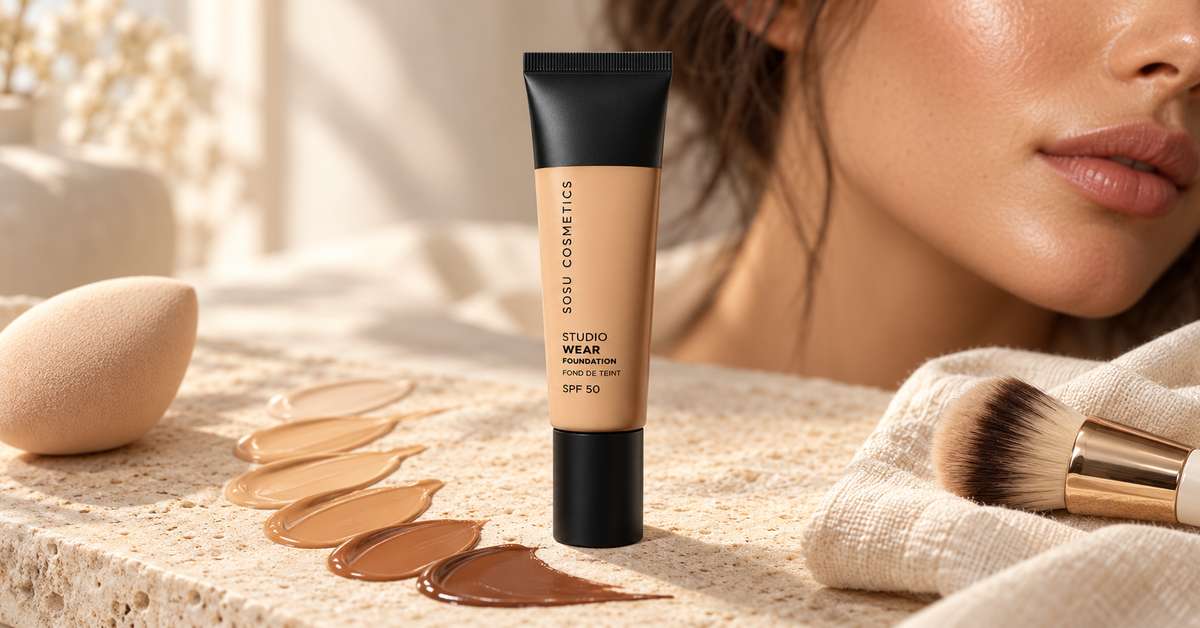
The Studio Wear available at the moment at SOSU, for instance, is claimed as medium to full and buildable, and the SOSU Canvas Complexion Palette allows people to build and tailor the coverage. Use less product and apply as necessary.
Oily skin is often best polished with matte or even natural finishes, while dry skin is more often comfortable with a dewy foundation. Satin is somewhere in the middle and may be a good solution, especially for combination skin.
How to Find Your Foundation Shade
However, shade depth is only a part of the picture. Undertone also matters.
Warm-coloured tones are golden, yellow or peach; cool-coloured tones are pink or rosy, and neutral tones lie somewhere in between. A slight green or golden hue can occur in olive skin tones.
Use a foundation shade finder to select colours, but view it as a starting point. To get a more accurate test:
-
Make 2 or 3 close swatches around the jawline area.
-
Look at them with your face and neck.
-
Test the shades during daylight hours.
-
Allow the formula to settle before choosing which one you should use.
Ideally, the image that you match to your face should fade in or out of sight not lighten, darken, or get pinker or warmer than your neck.
If you have self-tanned, keep in mind that your base colour might not be a perfect match for your skin tone on your neck and body. You do not have to go straight to your usual skin tone if you are wearing a pretty glowing tan, but for your base skin tone you should choose the right type.
Why Does Foundation Separate, Crease or Look Cakey?
Applying a poor foundation will almost always make it worse. Caking is often due to overdosing with product, overdosing with powder or dry skin. These can happen when skin becomes oily, the skin care has yet to be absorbed or when different layers of skin care are actually placed beneath one another.
Worse than using skincare that is suitable for your skin is when you do not let it absorb before you apply foundation and do it thinly from the centre of the face outwards. Use powder only when additional lubrication or protection against wear is required.
Choose Foundation for Your Skin, Not the Trend
The Best Foundation is the one that is true to your skin tone, covers your skin, and gives you the finish and tone you are looking for. Always use your skin tone first, then pick coverage to finish; check on your jaw and neck in natural light. This is much safer than a selection.
Frequently Asked Questions
How do I choose the best foundation formula for my skin type?
Assess your skin throughout the day. A new skin formula is recommended for dryness, as it will need more comfortable and hydrating ingredients to make it feel good; if you’re worried about having too much oil, lighter long-wear is the way to go; for combination, consider powdering instead of using a super matte formula all over.
How do I figure out my undertone to prevent a mismatched neck or flashback?
When picking a shade, try to make a few guesses based on the undertone and check the tone on the jaw and neck during the daytime. The type and amount of lighting provided, and the full makeup setup, can also affect a flashback, so try out your base setups with a photo before a big event.
What is the difference between light, medium and full coverage?
If the correction is visible, then it will be covered with light coverage; if it will not be visible but still noticeable, then it should be corrected using medium coverage; if the colour difference becomes almost impossible to see, then full coverage.
How can I stop foundation from separating, creasing or looking cakey?
Carry out skin preparation well but not so much as to add thickness and apply powder sparingly. Add extra coverage where necessary rather than expected.